

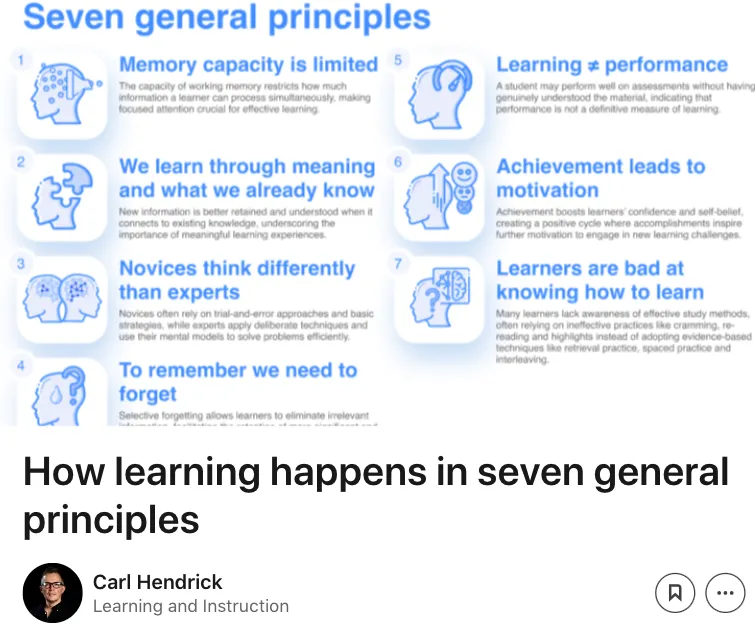
If ever I could recommend a book on learning, it would be this one: How Learning Happens by Paul A. Kirschner and Carl Hendrick.
Published this year in its second edition it debunks so many of the myths that we, as educators, have a tendency to cling onto (in the same way that Medieval doctors clung onto the myth that blood letting was an effective healing practice for an astonishing 800 years in Europe before a Swiss mathematician finally proved otherwise by a simple statistical table tracking casualty versus survival rates).
I like this book because it is easy to read, but if you want to go deeper, all the references are laid out for you to do so. It is designed to help, not to intimidate; and in some ways, I feel its structure reflects its ethos.
Some key findings and some of my own:
- There is no evidence to prove that adjusting teaching methods in line with students’ learning styles is effective. We need to stop talking about this because it is not helping anyone.
- Teaching is better facilitated by more obvious, more universal, and, weirdly, more nuanced methods. These can be roughly summarised as repetition, retrieval, regular assessment and encouragement.
- Asking students to repeat content they need to memorise drills the knowledge they need into place so that they can create scaffolds or knowledge skeletons onto which knowledge can be stabilised and thereby grow. Knowledge conceived in this way is more like a tree with strong roots (based on schemata theory from Jean Piaget).
- Scaffolding helps to organise new ideas into existing frameworks so that students can not only memorise and learn new information more efficiently, but they can problem solve more effectively because there is a greater and richer knowledge base to draw from. This becomes especially important in the latter educational years like A-level university but also afterwards in the career.
- Retrieval is a simple tool that I use in each class: simply ask the student to recall what they did in the last lesson. Do this each lesson. It helps to build knowledge, organise existing material, and structure the curriculum into a narrative, each class an episode in the series building relevance and connection with learning.
- Encouragement and close listening on the part of the teacher are musts. Students generally speak quite clearly when they say things like, “yes, but I don’t know HOW to do it.” This kind of response from a student means something very specific, even if the language is quite general. It is up to the teacher to LISTEN to what they are saying and ADJUST their responses accordingly. Too often, when I was at school, teachers would repeat themselves if I said I didn’t understand something putting the onus on me rather than that the instruction was irrelevant or unclear.
Learning can be strengthened easily with small tricks and we don’t need to pigeon hole students into being this way or that. There are tools that are universally applicable even if some students learn from them more quickly than others.
#learning #tutoring #education #learningwounds #howlearninghappens